Armbian
This guide walks you through installing MainsailOS on an Armbian-based SBC (such as Orange Pi) using the Raspberry Pi Imager.
Prerequisites
- A supported Armbian-based SBC (e.g., Orange Pi Zero 2, Zero 3, 3 LTS, or 4 LTS)
- A high-quality microSD card (minimum 16 GB, recommended 32 GB or more)
- An SD card reader
- Raspberry Pi Imager installed on your computer
SD Card Quality
We strongly recommend using a high-quality SD card of class A1 or better from a reputable manufacturer such as SanDisk, Kingston, or Samsung. Low-end cards tend to fail quickly in this kind of application.
Data Loss
Flashing will destroy all data on your SD card. This cannot be reversed. Make sure you select the correct drive.
Step 1: Prepare
Insert the microSD card into your card reader, connect it to your computer, and launch the Raspberry Pi Imager.
Step 2: Choose the Device
In the first step of the Raspberry Pi Imager, you will be asked to select the device you want to flash. Since we are using an Armbian-based SBC, scroll down and select No filtering to show all available images.
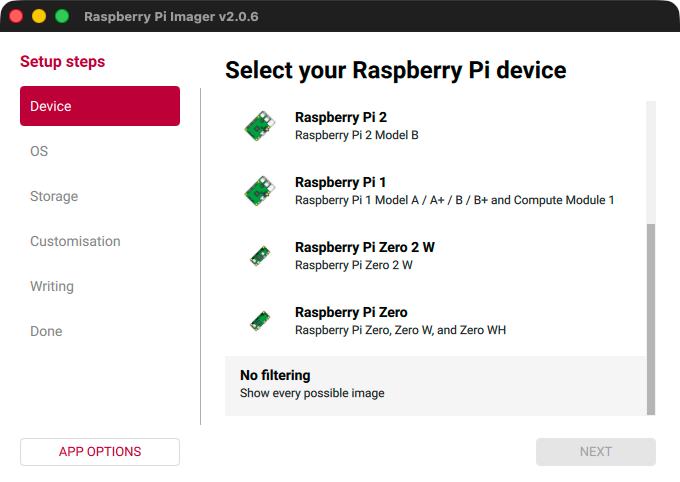
After selecting No filtering, click Next to proceed to the next step.
Step 3: Choose the OS
Now you need to select the correct OS image to flash. In the first level of the menu, you will find some popular operating systems. Scroll down until you find the Other specific-purpose OS category. Click on it to open the next level of the menu.
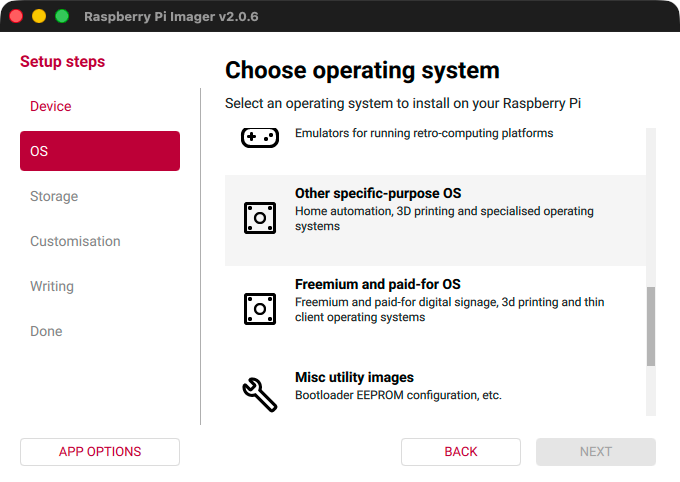
After clicking on Other specific-purpose OS, you will see the next level of the menu. Here, select 3D printing.
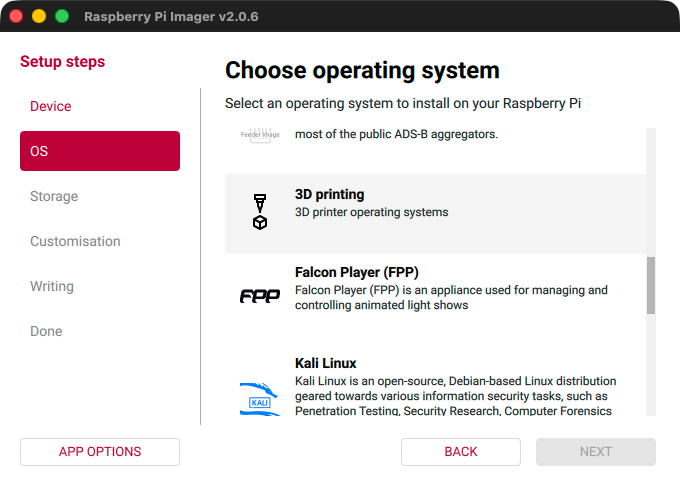
In the next menu, you will find the MainsailOS image. Click on it to select it.
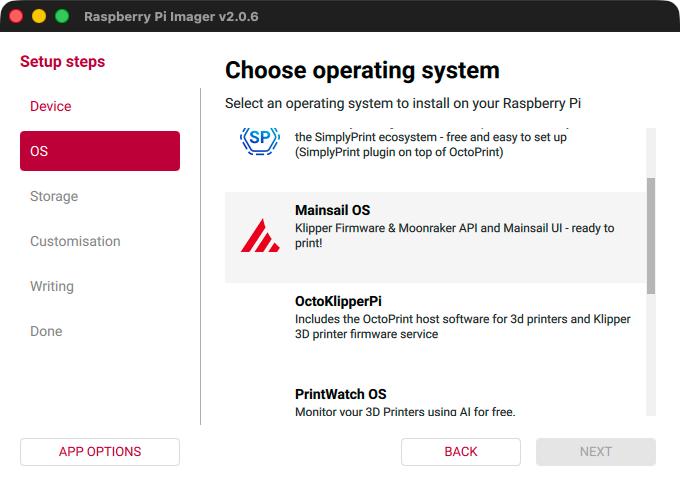
In the last step, you will see the available MainsailOS images for Armbian-based SBCs. Select the image that matches your board.
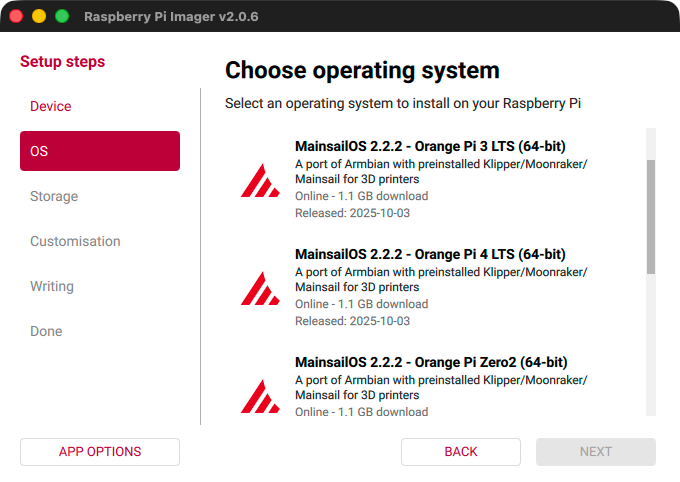
Select your board and click Next to proceed to the next step.
Step 4: Choose the Storage
Now you should see a list of available storage devices. Make sure to select the correct device, as all data on it will be erased during the flashing process.
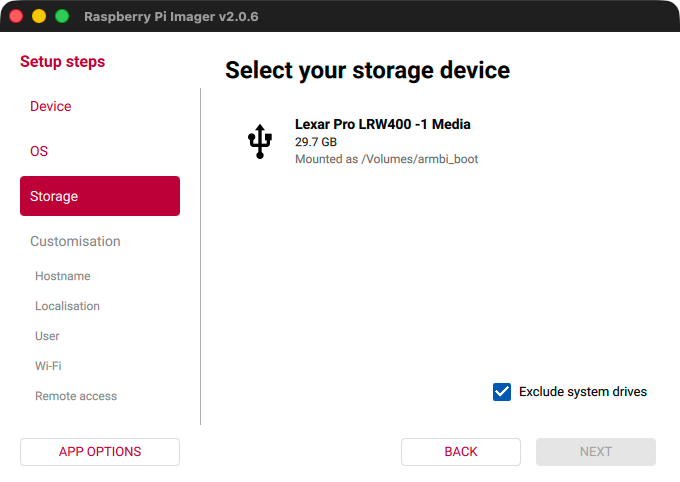
Select the correct storage device and click Next to proceed to the next step.
Step 5: Write the Image
Since Armbian-based images do not support the Raspberry Pi Imager's customisation step, you will be taken directly to the writing summary. Review your selections to make sure everything is correct. If you need to change something, you can click the "Back" button or use the left sidebar to navigate back to the respective step.
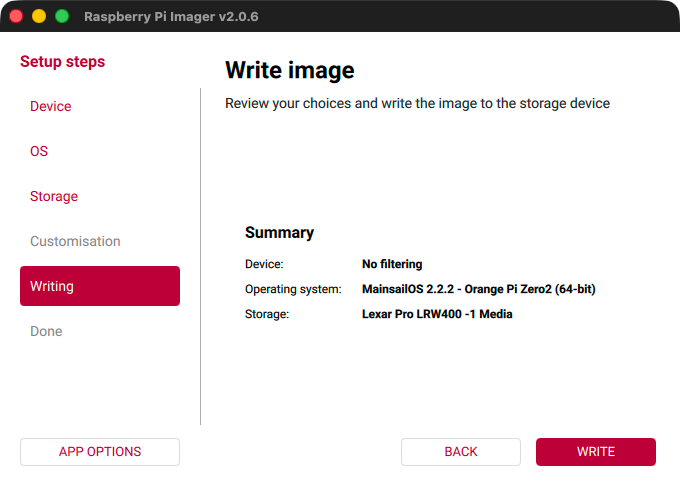
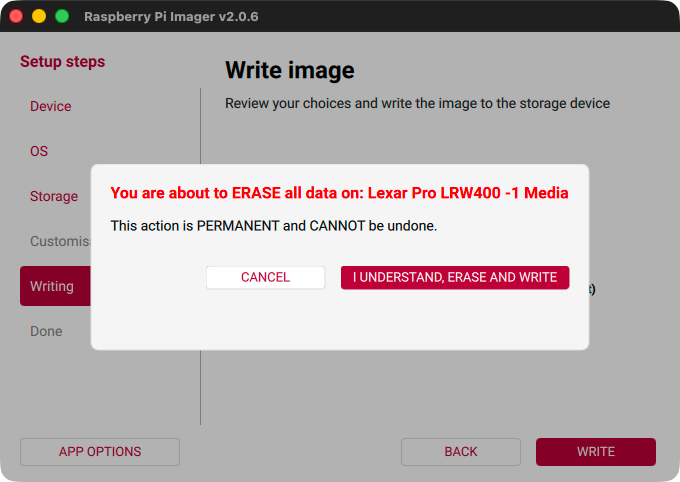
After clicking the "Write" button, you will be asked to confirm that you want to erase all data on the selected storage device. If you are sure that you have selected the correct device, click "I UNDERSTAND, ERASE AND WRITE" to start the flashing process.
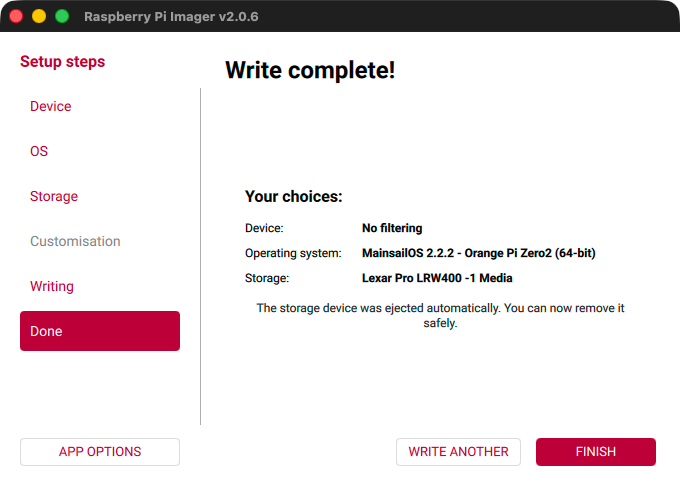
The flashing process will take a few minutes. When it has finished successfully, a confirmation message will be displayed.
Wi-Fi Configuration
Since the customisation step is skipped for Armbian-based images, Wi-Fi is not pre-configured. If your SBC is not connected via Ethernet, you can set up your Wi-Fi credentials before the first boot. Follow the Change WiFi credentials guide for instructions.
Default Login Credentials
The default login credentials for MainsailOS on Armbian-based SBCs are:
- Username:
pi - Password:
armbian
Change Your Password
For security reasons, we strongly recommend changing the default password after your first login.
Finished 🎉
Safely remove the SD card from your card reader, insert it into your SBC, and continue with the First Boot guide.